



Travel guide / Samarkand / Ulugh Beg Observatory
Ulugh Beg Observatory in Samarkand
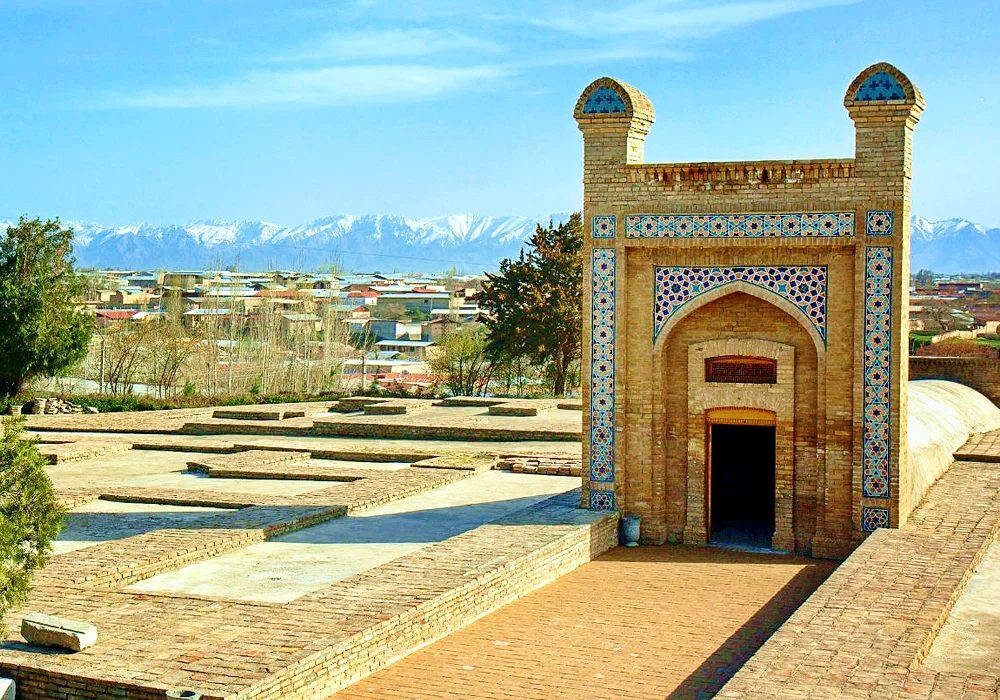
The Ulugh Beg Observatory was built in the 1420s and became one of the largest scientific centres of its time. Part of its main instrument — a gigantic stone sextant — has survived to this day.
History
Astronomers worked here whose research was far ahead of the European science of their day. The sextant was used to compile star tables that the scientific world relied on for several centuries.
Why it’s worth seeing
The observatory shows Samarkand as a city of knowledge and science, not only of religion and architecture. It is a good addition to the classic route.
What Ulugh Beg measured
The observatory was a multi-storey round building housing a giant sextant, an instrument for measuring the altitude of the stars. The arc of the sextant ran deep into the rock, and it is this underground section that survives today. Here astronomers compiled the Zij-i Sultani, a catalogue of more than a thousand stars and one of the most accurate made before the telescope. Ulugh Beg measured the length of the sidereal year with an error of less than a minute, in the 15th century.
How it was found
After Ulugh Beg was killed in 1449 the observatory was destroyed, and for centuries it vanished underground. In 1908 the archaeologist Vasily Vyatkin, working from old documents, located its foundations and the underground part of the sextant. Vyatkin is buried here, beside the work of his life.
Practical information
The observatory stands on Kuhak Hill in the north-east of the city; from the centre it is easiest to go by car. Next to it is a small museum with copies of manuscripts and a model of the building. Allow an hour and combine the visit with the Afrasiab settlement and its museum of Sogdian frescoes. Entry is by ticket, and we confirm current prices and opening hours before your trip.
SÁTRA tip
Plan the observatory for your second day in Samarkand together with other sights outside the centre, so you don’t waste time on extra transfers.
Where it fits in a trip
The Ulugh Beg Observatory is part of our tours “Ancient Duet”, “From the Aral Sea to Samarkand”, “Classics of the East”, “Three Capitals of the East”, “Timur’s Path”, “The Great Silk Road”, “From West to East”, all of which include Samarkand, or build your own itinerary in the tour builder.
More in Samarkand
Travelling to Samarkand?
We will show you the city with a guide who knows every detail and plan an itinerary for your dates. Message our manager — we will answer your questions and find the right tour.
Fresh travel tips in our Telegram channel.