



Travel guide / Bukhara / Ulugh Beg and Abdulaziz Khan madrasahs
The Ulugh Beg and Abdulaziz Khan madrasahs in Bukhara
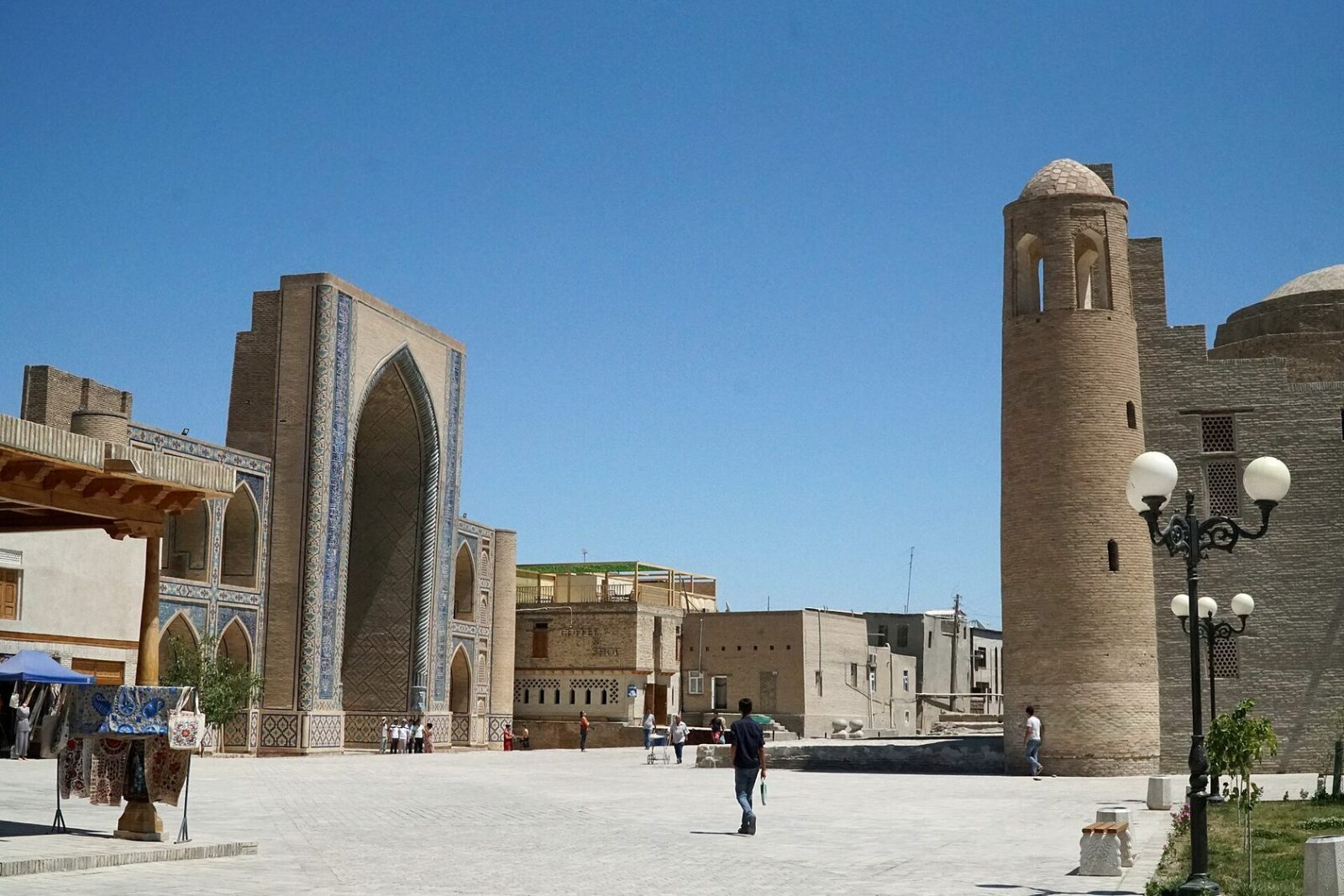
Between the Toki Zargaron trading dome and the Poi-Kalyan ensemble two madrasahs stand face to face, separated by two and a half centuries. The Ulugh Beg Madrasah is the oldest surviving one in Central Asia, restrained and geometric. The Abdulaziz Khan Madrasah is the last great building of the Bukhara khans, with bright majolica and images rare in Islamic art. Together they show how Bukhara’s taste changed.
The Ulugh Beg Madrasah, 1417
Timur’s grandson, the astronomer-ruler Ulugh Beg, built his Bukhara madrasah three years before the one in Samarkand. Over the entrance an inscription reads: “The pursuit of knowledge is the duty of every Muslim man and woman.” The façade is modestly decorated: star patterns, a carved door, small corner towers. Inside is a courtyard with hujras where students lived and two lecture halls in the corners. It is a model of early Timurid architecture, where proportion matters more than ornament.
The Abdulaziz Khan Madrasah, 1652
Across the street the Ashtarkhanid ruler Abdulaziz Khan built a madrasah twice as ornate. The portal is covered in majolica with floral patterns, and among the flowers the mosaic hides birds and even the outlines of a dragon and a Chinese phoenix, an unusual liberty for a Muslim building. Inside survive the painted winter mosque and carved stalactite vaults. The madrasah was never finished: parts of the walls were left without facing.
Why they face each other
This arrangement is called a “kosh”, a pair. In Bukhara and Samarkand it was a common device: a new building was set facing an old one to show continuity and at the same time outdo its predecessor. Standing in the middle of the street, you can easily compare how strict geometry gave way to painterly splendour over two centuries.
Practical information
Both madrasahs are on the main pedestrian street of the old town, two minutes from Toki Zargaron and five from Poi-Kalyan. Craft shops and small exhibitions now occupy the interiors; entry to the courtyards is usually free. The Abdulaziz Khan façade is best lit in the evening.
SÁTRA tip
Stand in the middle of the street between the two portals and look at one, then the other: the difference of two and a half centuries is visible without any commentary. Then step into Ulugh Beg’s courtyard, which stays quiet even in high season.
Where it fits in a trip
Both madrasahs are part of the old-town walk on our tours “Ancient Duet”, “From the Aral Sea to Samarkand”, “Classics of the East”, “Three Capitals of the East”, “Timur’s Path”, “The Great Silk Road”, “From West to East”, or build your own itinerary in the tour builder.
More in Bukhara
Travelling to Bukhara?
We will show you the city with a guide who knows every detail and plan an itinerary for your dates. Message our manager — we will answer your questions and find the right tour.
Fresh travel tips in our Telegram channel.