



Travel guide / Bukhara / Poi-Kalyan
Poi-Kalyan ensemble in Bukhara
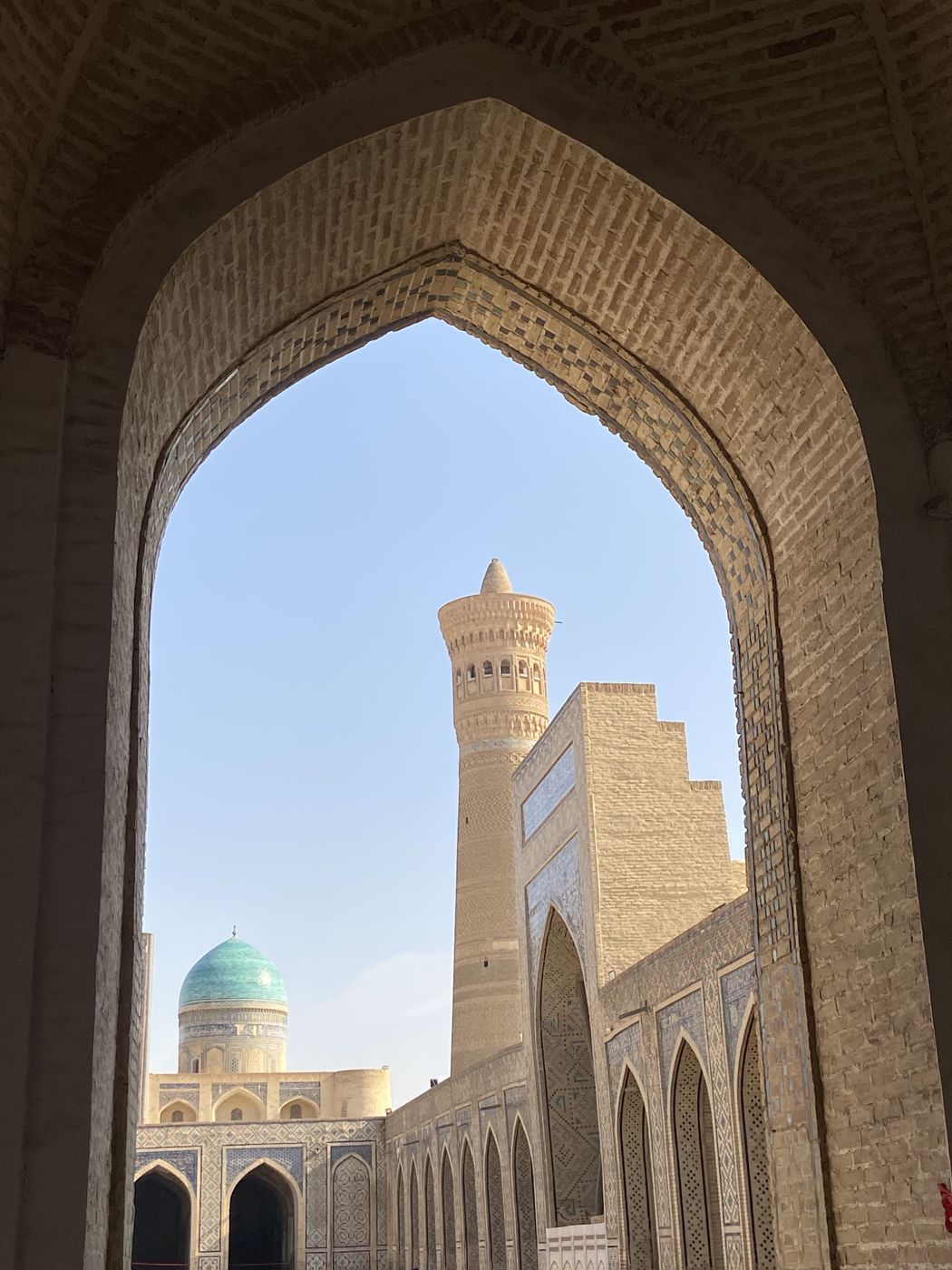
Poi-Kalyan is the main spiritual and architectural centre of Bukhara. The ensemble consists of the Kalyan Minaret, the Kalyan Mosque and the Mir-i-Arab Madrasah, which together form the main square of the old town.
Kalyan Minaret
The minaret was built in 1127. It is about 46 metres high (sources vary from 45.6 to 48 m). It is an early masterpiece of the Karakhanid era, and it defines the skyline of Bukhara’s historic centre.
The mosque and the madrasah
The Kalyan Mosque and the Mir-i-Arab Madrasah form the main square, where you feel Bukhara most strongly as a religious and educational centre. Even a short visit to Poi-Kalyan is usually the moment when Bukhara “comes together” in your mind.
How to look at the minaret
The Kalyan Minaret is built entirely of fired brick, and its whole beauty lies in how that brick is laid. The shaft is wrapped in bands of different patterns, and no band repeats its neighbour. At the top is a lantern with arched openings, from which the muezzin called the faithful to prayer, and a narrow band of turquoise glaze, one of the early examples of coloured glaze in the region's architecture. The patterns read best in low light, early in the morning and at sunset.
Legends and facts
The best-known legend says that in 1220 Genghis Khan, who destroyed Bukhara, threw back his head to look at the minaret, dropped his hat and, bending to pick it up, ordered the tower spared, since it had made him bow. The minaret also served as a lighthouse: caravans could see it long before they reached the city. It has a darker nickname too, "the tower of death", from stories that criminals were thrown from the top. The Mir-i-Arab Madrasa is one of the few in the region that kept working through the Soviet period.
Practical information
Poi-Kalyan is a 5-minute walk from the Ark and next to the trading domes, which makes it the natural centre of any walk through old Bukhara. You can walk freely around the square between the mosque and the madrasa; Mir-i-Arab is a working madrasa, and visitors are usually allowed only into the entrance hall. The minaret is closed for climbing. In the evening the ensemble is lit up, and the best view is from the rooftop cafés around the square.
SÁTRA tip
Look at the minaret twice: during the day to study the brickwork patterns, and in the evening when the ensemble is illuminated.
Where it fits in a trip
Poi-Kalyan is part of our tours “Ancient Duet”, “From the Aral Sea to Samarkand”, “Classics of the East”, “Three Capitals of the East”, “Timur’s Path”, “The Great Silk Road”, “From West to East”, or build your own itinerary in the tour builder.
More in Bukhara
Travelling to Bukhara?
We will show you the city with a guide who knows every detail and plan an itinerary for your dates. Message our manager — we will answer your questions and find the right tour.
Fresh travel tips in our Telegram channel.